Why I Serve on the Governors Military Council
Updated: Sep 6
One thing I've learned through service on the California Governor’s Military Council is that national security spending has a much larger impact on our local economy than many people realize.

California’s National Security Economy
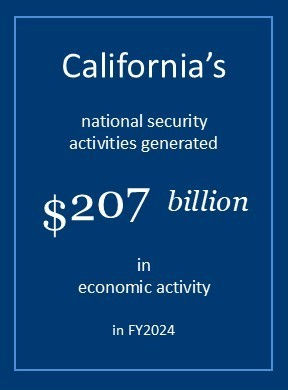
California is home to more than 30 federal military installations. During fiscal year 2024, military and national security activity generated an estimated $207 billion in economic activity, representing approximately 5% of the state’s economy.
The sector also supports an estimated 339,000 uniformed and civilian personnel.
Those numbers include researchers developing new technologies at the Naval Postgraduate School, instructors preparing service members for global assignments at the Defense Language Institute, contractors supporting military operations, and local businesses serving installations and military families.
California also offers capabilities that are difficult to replicate elsewhere. Our geography supports extensive land, air, sea, and space ranges. Our universities contribute advanced research and a highly skilled workforce. California’s technology, aerospace, manufacturing, and research sectors help move ideas from laboratories into practical use.
These assets place our state at the center of national conversations about the Pacific, cybersecurity, artificial intelligence, space operations, and military readiness.
Governors Military Council
I am proud to serve on the Governor’s Military Council, which brings together retired military leaders, state officials, legislators, and civic leaders to advise the Governor on California’s military installations and national security missions.
The Council works to retain important military operations, strengthen relationships with defense communities, and position California for future investment. In 2025, state leaders extended its authorization through 2031, recognizing the need for sustained attention to these issues.
For me, this service is deeply personal.
I spent 22 years in the United States Air Force, and Monterey and Pacific Grove played important roles in my military education. I understand our defense institutions as national assets, major employers, centers of discovery, and valued members of the communities that support them.
The Council gives state agencies, military leaders, legislators, and community representatives a forum to address issues that cross institutional boundaries. These include housing and workforce needs, infrastructure and resilience, land-use compatibility, environmental stewardship, and supply-chain capacity.
At its October 2025 meeting in Monterey, the Council examined how future economic studies could align with California Jobs First, improve regional analysis, assess workforce quality, and identify supply-chain vulnerabilities. This work can help communities compete for investment while supporting military readiness.
Monterey County
The military and national security community is woven into Monterey County’s economy and identity.

The 2025 California Military Economic Impact Study identifies approximately 13,070 military and national security-related civilian personnel in Monterey County.
Their work, together with associated federal spending, generated an estimated $4.27 billion in total economic output and supported approximately 16,351 full-time-equivalent jobs.
This is about 11% of total economic activity in the county, which means that the impact of installations like NPS, DLI, the Coast Guard station, and others reaches far beyond their gates.
Military and civilian personnel live in our neighborhoods, shop at local businesses, use community services, and volunteer throughout the county.

Students and international officers bring their families to the region, while veterans continue contributing long after their military service concludes.
Centers of Learning and Innovation
What happens at military installations right here on the Monterey Peninsula is especially distinctive because so much of it is built around education, research, and human capability.
The Defense Language Institute Foreign Language Center has capacity for approximately 3,500 students and employs about 1,500 highly educated instructors. Its broader programs have taught more than 65 languages and prepared generations of service members to work effectively across cultures.
The Naval Postgraduate School provides defense-focused graduate education and interdisciplinary research addressing real operational challenges. Its work spans areas such as cybersecurity, ocean sciences, autonomous systems, space operations, and artificial intelligence.
That work continues to grow. In July 2026, one of the world’s most powerful artificial intelligence computing platforms came online at NPS. The system will support more than 1,500 students and 600 faculty members working on applications that include cybersecurity, weather prediction, and disaster response planning.
Monterey County also includes Fort Hunter Liggett, Camp Roberts, a major Defense Human Resources Activity presence, and the Major General William H. Gourley VA-DoD Outpatient Clinic.
Together, these institutions make our region a center for military education, operational training, advanced research, and veteran support.
Bringing a Local Perspective to Sacramento
Serving on the Governor’s Military Council reinforces that the strength of our national security depends on communities like ours.
I'm proud to bring the perspective of Monterey County and Pacific Grove to the Governor’s Military Council.
I'm equally proud to help California approach national security as both a federal mission and a responsibility shared by the state and the communities like ours that make these missions possible.
More information about the economic impact of California's contributions to our national security can be found here. Disclaimer: Mention of Department of Defense or state of California entities is provided for biographical context and does not imply endorsement.